Screenprinting
Also known as: silkscreen, serigraphy, screenprint, screen printing
Ink is pulled across a mesh screen using a squeegee, passing through the open areas of a stencil. The ink deposits a flat, even layer of color with sharp edges.
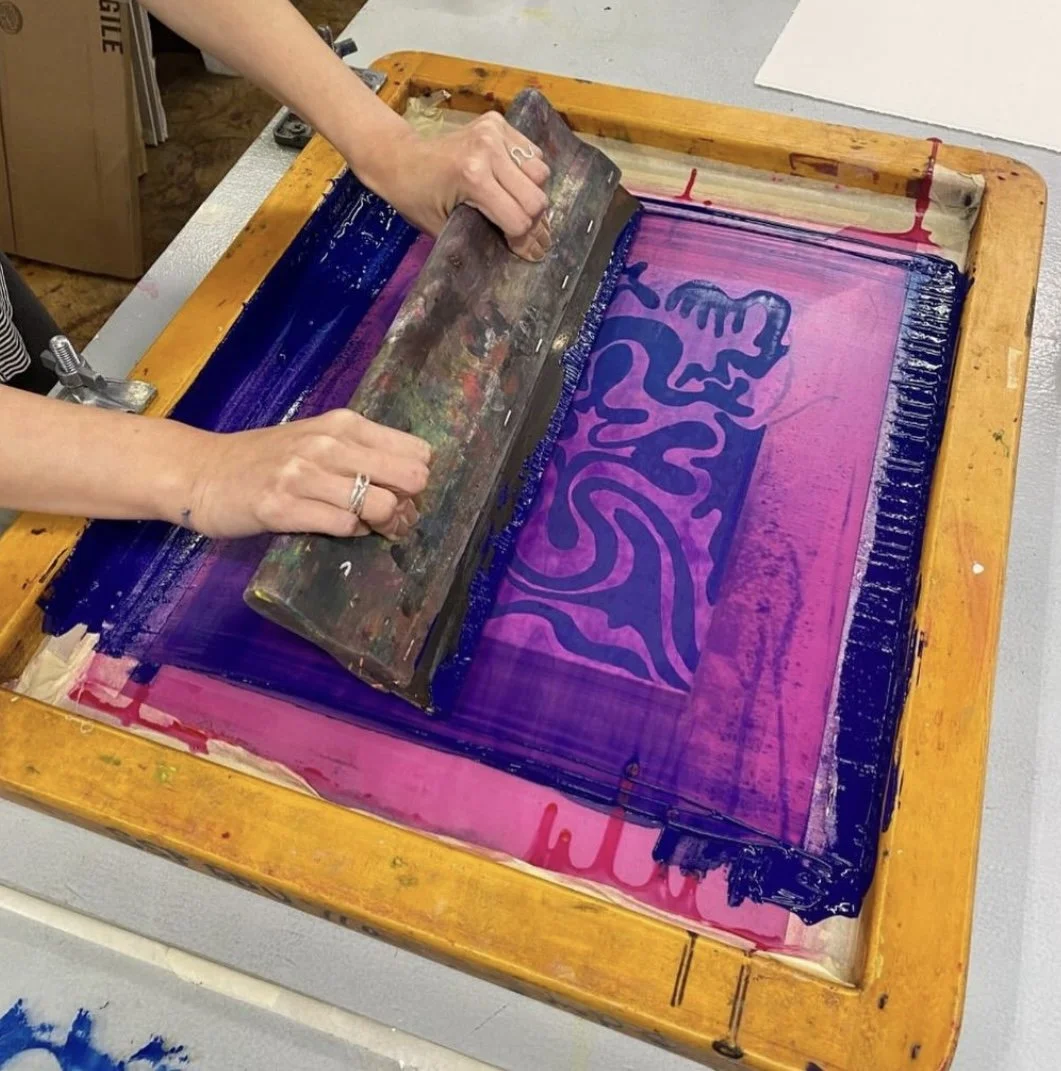
A screen printer pulls ink across a silk screen using a squeegee during the screen printing process. Source: Second State Press
Table of contents
Screenprinting is a stencil-based printmaking process in which ink is pushed through a mesh screen onto paper, fabric, or other surfaces below, with a stencil blocking the areas that should not receive ink.
It’s one of the most versatile printmaking processes in existence, used across fine art printing, commercial production, and textile design. In the fine art context it is known as serigraphy, and a print produced by the process is called a serigraph.
What is screenprinting?
Screenprinting works by forcing ink through the open areas of a mesh screen stretched over a frame. A stencil applied to the screen blocks certain areas of the mesh, preventing ink from passing through. Where the mesh is open, ink is transferred directly to the paper, fabric, or other surface below.
The process is known by several names, all referring to the same fundamental method. Screenprinting (or screen printing) is the general term. Serigraphy is the fine art term, derived from the Latin seri (silk) and the Greek graphia (writing), coined in the late 1930s to distinguish fine art screen printing from commercial use. Silkscreen printing and silk screen printing are older terms referencing the silk mesh originally used; polyester has largely replaced silk in contemporary practice. A serigraph or a screenprint is a print produced by the process in a fine‑art context, typically either as a unique work or as part of a limited edition.
Screenprinting is classified as a stencil process, one of the types of printmaking alongside relief, intaglio, planographic, and digital. This is what makes it structurally distinct from every other major print process: the ink passes through the matrix rather than from its surface (relief), from below the surface (intaglio), or from a flat surface (planographic). The screen is both the carrier of the stencil and the mechanism of ink transfer.
The process is practiced at every scale, from single-artist print studios producing fine art editions on paper to industrial operations printing millions of garments, circuit boards, and product labels. The fine art tradition and the commercial tradition share the same underlying process but differ significantly in intent, materials, and the character of the resulting work.
How screenprinting works
The screenprinting process follows a distinct sequence of stages, each of which contributes to the final print.
1. Preparing the screen
A fine polyester mesh is stretched tightly over a rigid frame, typically aluminium or wood, and stapled or adhered in place under tension.
The mesh count — the number of threads per inch (TPI) or threads per centimeter (TPC) — determines the level of detail the screen can hold and the type of ink appropriate for the job:
- A low mesh count (36–156 TPI) holds more ink and is suited to bold, low-detail designs and heavy specialty inks such as glitter or shimmer.
- A high mesh count (180–400 TPI) deposits less ink, allowing finer detail for halftone and process color work.
2. Creating the stencil
The stencil defines where ink will and will not pass through the mesh.
Several methods exist for creating a stencil, but the most common in both fine art and commercial contexts is photo emulsion.
A light-sensitive emulsion is applied evenly across the mesh and allowed to dry in darkness. A film positive (the artwork rendered in opaque black on a transparent sheet) is placed directly on the coated screen and the assembly is exposed to ultraviolet light.
The emulsion hardens everywhere the UV light reaches. The areas beneath the black artwork, shielded from the UV light, remain soft. The screen is then washed with water: the hardened emulsion stays in place, blocking the mesh; the unexposed areas of emulsion wash away, leaving open mesh through which ink will pass.
The film positive used to expose the emulsion can be produced in several ways. The most common is a digitally produced transparency printed on an inkjet or laser printer with opaque black ink.
Transparencies can also be produced by painting or drawing directly onto acetate or polyester film with opaque inks or drawing materials, which gives the image a more gestural, hand-made character that carries through into the stencil.
Rubylith (a red-coated masking film) is a traditional alternative in which the artist cuts the image by hand directly into the film, peeling away the areas that should print. It produces very clean, hard-edged stencils and is still used by printmakers who prefer a direct, tactile working method.
For bolder, more graphic work, some printmakers skip emulsion entirely and use hand-cut paper stencils placed against the mesh — a faster, more immediate method, though less durable than emulsion for longer editions.
3. Printing
The screen is positioned in a press or printing frame above the material being printed.
Ink is placed at one end of the screen. A squeegee (a rubber blade in a wooden or aluminium handle) is drawn across the screen under firm, even pressure. The squeegee forces ink through the open mesh onto the substrate below. One pass of the squeegee produces one impression.
The substrate is then carefully peeled away from the screen to reveal the print, and the next sheet is registered and placed for printing.
4. Multi-color printing
Each color in a screenprint requires a separate screen, each with its own stencil carrying only the areas of the design corresponding to that color. Colors are printed in sequence — typically from lightest to darkest — with each impression registered accurately to the previous.
The registration of multiple screens is one of the central technical challenges of the process, and the relationship between overlapping color layers is central to the aesthetic decisions made at the design stage.
Fine art serigraphs may use anywhere from one to thirty or more colors, each representing a separate screen, a separate stencil, and a separate pass. The accumulation of layers is what gives fine art screenprints their characteristic depth, density, and luminosity.
5. Cleaning and reclaiming
After printing, residual ink is removed from the screen. In fine art studios, screens are reclaimed for reuse: a chemical reclaiming solution dissolves the emulsion, the screen is washed clean, and the mesh is ready to receive a new emulsion coating and a new image. A well-maintained screen can be reclaimed and reused many, many times.
Materials and tools
The screen
The screen frame is typically aluminium in professional and fine art settings — lightweight, rigid, and resistant to warping from moisture and cleaning chemicals. Wooden frames are used in educational settings and by beginners. The frame must hold the mesh under consistent tension; a sagging or uneven mesh produces inconsistent ink deposit.
Polyester mesh is now the standard material. It is dimensionally stable, resistant to solvents, and holds tension reliably.
Silk, which gave silkscreen printing its name, is rarely used in contemporary practice.
Emulsion
Photo emulsion is the standard stencil-making medium for most fine art and commercial screenprinting. It is applied to the mesh as a liquid, dried, exposed to UV light through a film positive, and washed with water to remove the unexposed areas, leaving open mesh where ink will pass through. The hardened emulsion forms the stencil.
Photo emulsion allows for photographic precision and fine tonal work including halftones — qualities not achievable with hand-cut stencils alone.
Emulsion formulations vary: some are designed for water-based inks, others for solvent-based or plastisol systems. Using the wrong emulsion for the ink type causes stencil breakdown.
The squeegee
The squeegee is the tool that drives ink through the mesh. The rubber blade is available in different durometer (hardness) ratings: a softer blade deposits more ink and is better suited to textured surfaces; a harder blade produces a thinner, sharper ink deposit and is preferred for detailed or halftone work. The blade must be kept clean and free from nicks, which cause lines of uneven ink deposit in the print.
Ink
Water-based ink is the standard ink type for fine art serigraphy on paper. It soaks into the substrate rather than sitting on top of it, producing a surface quality well suited to fine art papers and a more favorable environmental profile than petroleum-based alternatives. Water-based inks require attentive printing and cleaning rhythms because they begin to dry in the mesh if left too long between passes.
Plastisol ink is a PVC-based ink that does not dry at room temperature and must be cured with heat. It is the dominant ink type in commercial textile printing — the ink behind most printed garments — valued for its vibrant, opaque color and durability on fabric. It is less commonly used in fine art paper printing.
Both ink types are available in a wide range of colors, and both can be mixed to produce custom colors. The opacity of the ink (how much it covers the surface beneath) is a key variable in designing multi-color screenprints, since a transparent ink printed over another will create a visual mixture, while an opaque ink will cover what is beneath it.
Substrates
Screenprinting can be applied to almost any flat substrate that can be held in registration beneath the screen.
Paper is the primary substrate for fine art serigraphy. Heavy fine art papers are standard for edition work, with the weight and surface texture significantly affecting the character of the print.
Fabric is the primary substrate for commercial screenprinting; most printed garments are produced by screenprinting. Other substrates include wood, glass, metal, ceramic, and plastic, depending on the application.
Serigraphy as a fine art medium
Serigraphy and commercial screen printing use the same process. What distinguishes them is context, intent, and production method. A serigraph is produced in a limited edition on fine art paper, with each color screen designed by the artist and the printing overseen by the artist or a master printer working under their direct supervision. The edition is numbered and signed, and each impression is considered an original print.
A serigraph is not considered an original print when it is a photographic reproduction of a pre‑existing painting or drawing, transferred to the screen mechanically. This distinction matters in the art market: both types are sometimes sold simply as “serigraphs,” but only the former — where the image is conceived and developed specifically for the screen — carries the status of an original print. The difference is often discernible to the trained eye in the way color areas behave and in the relationship between the image and the screen structure.
Color is the defining formal strength of serigraphy. The process produces areas of flat, opaque, pure color that are extremely difficult to achieve in any other printmaking medium. Lithography can approach this quality but tends toward a more tonal, atmospheric result; etching and relief processes are fundamentally line- and texture-based. Screenprinting's capacity for flat, saturated, high-contrast color made it the natural medium of Pop Art, and remains central to its contemporary fine art appeal.
Multiple colors build up in layers, and the sequence and opacity of each layer is a key design decision. A transparent color printed over a solid one creates a third color through optical mixture. An opaque color printed over another hides what is beneath it. These relationships between layers are worked out at the design stage and tested through proofing before the edition is printed.
The number of screens in a fine art serigraph ranges widely — from two or three for graphic work to twenty, thirty, or more for complex tonal or photographic imagery. Each additional screen adds time, cost, and registration complexity. A serigraph with a high screen count is a significant technical achievement and is generally reflected in the edition price.
A brief history of screenprinting
Stencil-based image-making has deep roots across multiple cultures. Japanese katazome textile stencils, in which designs were cut into mulberry paper treated with persimmon juice to make it water-resistant, represent one of the oldest and most sophisticated stencil traditions, developed over centuries. Stencilled patterns on fabric and paper also appear in Chinese and Polynesian traditions well before the modern screen process.
The direct ancestor of contemporary screenprinting emerged in England in the early 20th century. Samuel Simon patented a silk-screen stencil process in 1907, and commercial applications developed quickly through the 1910s and 1920s, particularly for poster printing, display graphics, and fabric decoration. The process spread rapidly in the United States and became a significant commercial printing method before it had established any presence in fine art.
The transition to fine art use began in America in the 1930s. Artists associated with the Federal Art Project (part of the New Deal's Works Progress Administration) began exploring screenprinting as a printmaking medium. Anthony Velonis, a printmaker and administrator working within the project, is credited with coining the term serigraphy around 1937–1938, explicitly to distinguish fine art screen printing from its commercial applications and to argue for its legitimacy as an original print medium.
The process achieved its most transformative fine art moment through Pop Art in the 1960s. Andy Warhol's use of silkscreen — for the Marilyn series, the Campbell's Soup Cans, and the Mao portraits, among many others — placed screenprinting at the center of contemporary art discourse. Warhol's choice was not incidental: the mechanical, photographic, and reproductive qualities of the silkscreen process embodied his ideas about mass production, celebrity, the circulation of images, and the relationship between art and commerce. Robert Rauschenberg and Jasper Johns also worked with the medium in this period, extending its possibilities in different directions.
In the decades following Pop Art, serigraphy was adopted by artists working in a wide range of styles and traditions. It became a significant medium in poster art, particularly in the psychedelic concert poster movement of the late 1960s and the political poster movements of the 1970s and 1980s. Contemporary fine art serigraphy encompasses everything from tightly controlled geometric abstraction to complex photographic imagery to gestural work exploiting the specific material qualities of the ink.
Screenprinting in relation to other processes
Screenprinting and lithography
Both are major fine art printmaking processes capable of complex, multi-color work in large editions, but they produce quite different results.
Lithography draws on an autographic tradition: the artist draws directly on the stone or plate, and the resulting marks reflect the hand closely.
Screenprinting builds color through layers of ink pushed through a mesh, which lends itself to flat, saturated areas but is equally capable of photographic detail and subtle tonal gradation through halftones and transparent ink layers.
The two processes can also be used together, with different colors or elements of the same print produced by each method, combining lithography's tonal mark-making with screenprinting's capacity for flat, saturated color.
Screenprinting and giclée
A serigraph is an original print produced through a manual, screen-based process. A giclée is a digital inkjet print, capable of photographic detail and an effectively unlimited color gamut produced in a single pass. The two are frequently confused in the secondary art market, and the confusion is sometimes deliberate.
A serigraph can be identified by the slight body of the ink on the surface of the paper, visible layer relationships between colors, and in many cases a faint texture from the mesh. A giclée is smooth and continuous-tone, with no ink body and no visible layer structure.
Screenprinting and digital printing
Digital printing (including both fine art giclée and commercial direct-to-garment printing) produces images from digital files without physical screens or stencils. Screenprinting requires a separate physical screen for each color and produces a different surface quality — more tactile, more opaque, with visible ink body on the substrate. The physical and material presence of screenprinting is a significant part of its value to many artists and collectors, in the same way that the hand of the printmaker is present in a woodcut or an etching.
Frequently asked questions
What is a serigraph?
A serigraph is a fine art print made by the screenprinting process. The term distinguishes limited-edition fine art screen prints — designed by the artist, produced under their direct supervision, signed and numbered — from commercial screen printing. A serigraph is considered an original print when the artist directly created the stencils and oversaw the printing. It is not an original when it is a photographic reproduction of a pre-existing work transferred to screen.
What is the difference between serigraphy and screen printing?
The process is identical. Serigraphy is the fine art usage of the screenprinting process: limited editions on fine art paper, designed and produced by or under the direct supervision of the artist, numbered and signed. Screen printing as a broader term encompasses commercial applications — apparel, signage, packaging, and industrial uses — as well as fine art. All serigraphs are screen prints; not all screen prints are serigraphs.
What is the difference between a serigraph and a lithograph?
Both are original fine art prints produced in limited editions. A serigraph is made by pushing ink through a mesh screen; a lithograph is made from a flat stone or plate using the oil-and-water principle. Serigraphs are often characterized by flat, opaque areas of color and visible layering. Lithographs tend toward tonal, atmospheric qualities that reflect the autographic marks made directly on the stone or plate. Both processes are capable of complex color work, but they produce distinctly different visual results.
How many colors can a screenprint have?
There is no technical limit. Fine art serigraphs commonly use anywhere from two to thirty or more colors, each requiring a separate screen with its own stencil. More colors increase production time, cost, and registration complexity. Some contemporary serigraphs involve fifty or more screens and represent months of printing work.
What is the difference between screenprinting and digital printing?
Screenprinting uses a physical mesh screen and stencil to push ink onto the substrate. Digital printing prints from a digital file using inkjet technology, without physical screens or stencils. Screenprinting produces a more tactile, opaque surface with visible ink body; digital printing can reproduce photographic detail and an unlimited range of colors in a single pass. In fine art contexts, the physical and material qualities of the screenprinted surface are part of its value and character.
Why did Andy Warhol use silkscreen?
Warhol's use of silkscreen was deliberate and conceptually motivated. The photographic, mechanical, and reproductive qualities of the process — its ability to repeat an image across a series with controlled but not identical variation — aligned with his ideas about mass production, celebrity culture, and the circulation of images in consumer society. The process also allowed him to work at the scale and speed his practice demanded, and to blur the distinction between artist's hand and mechanical production, which was central to his project.