Lithography
Also known as: litho
Greasy drawing materials are applied to a flat stone or plate and chemically treated to separate image and non-image areas. Ink adheres only to the drawn areas and prints with a wide range of tones and textures.
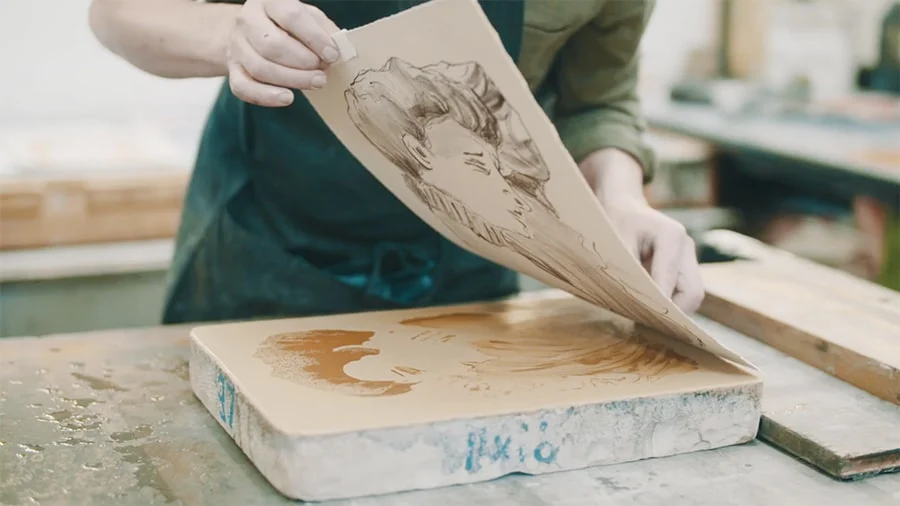
A lithographic print being pulled from the surface of a litho stone. Source: TKSST
Table of contents
Lithography is a planographic printmaking process based on the natural repulsion between oil and water. An image is drawn or applied to a flat surface, traditionally limestone, using greasy materials. Through chemical processing, the image areas attract ink while the non-image areas repel it, allowing the image to be printed without carving or engraving the surface.
Because lithography preserves the qualities of drawing — line variation, texture, and tonal subtlety — it has long been valued by artists who want prints to closely reflect the look and feel of their original marks.
This process has been central to both fine art printmaking and commercial printing since its invention in the late 18th century.
What is lithography?
Lithography is a printing process in which the image and the non-image areas sit on the same flat surface. There is no carving, cutting, or etching involved. Instead, the process relies on a simple chemical principle: oil and water do not mix.
The artist draws or paints an image onto the printing surface using oil-based materials. The surface is then chemically treated so that the image areas attract oil-based ink and the non-image areas attract water and repel ink. When the surface is dampened and inked before each print, the ink adheres only where the image was drawn. Paper is pressed onto the surface to transfer the ink, producing the print.
Because the printing surface is flat rather than raised or incised, lithography is a planographic process. Planographic printing is the category of printmaking in which ink transfers from a flat surface, as distinct from relief printing (where ink sits on raised surfaces, as in woodcut or linocut) and intaglio printing (where ink sits in incised grooves, as in etching or engraving), stencil printing (where ink passes through open areas of a stencil, as in screenprinting), and digital printing (where ink is deposited by machine from a digital file, as in giclée).
A lithograph is the print produced by this process. In fine art, a lithograph is an original multiple: each impression is printed directly from a matrix made by the artist, and the edition is considered original work rather than a reproduction.
The word lithography comes from the Greek líthos (stone) and gráphein (to write), a reference to the limestone block on which the process was originally developed. The term lithograph refers to an individual print made by this method.
How lithography works
The lithographic process follows a sequence of distinct stages, each of which is essential to producing a clean, well-printed impression. The steps described here apply to traditional stone lithography, which remains the foundation for understanding all other lithographic methods.
1. Preparing the surface
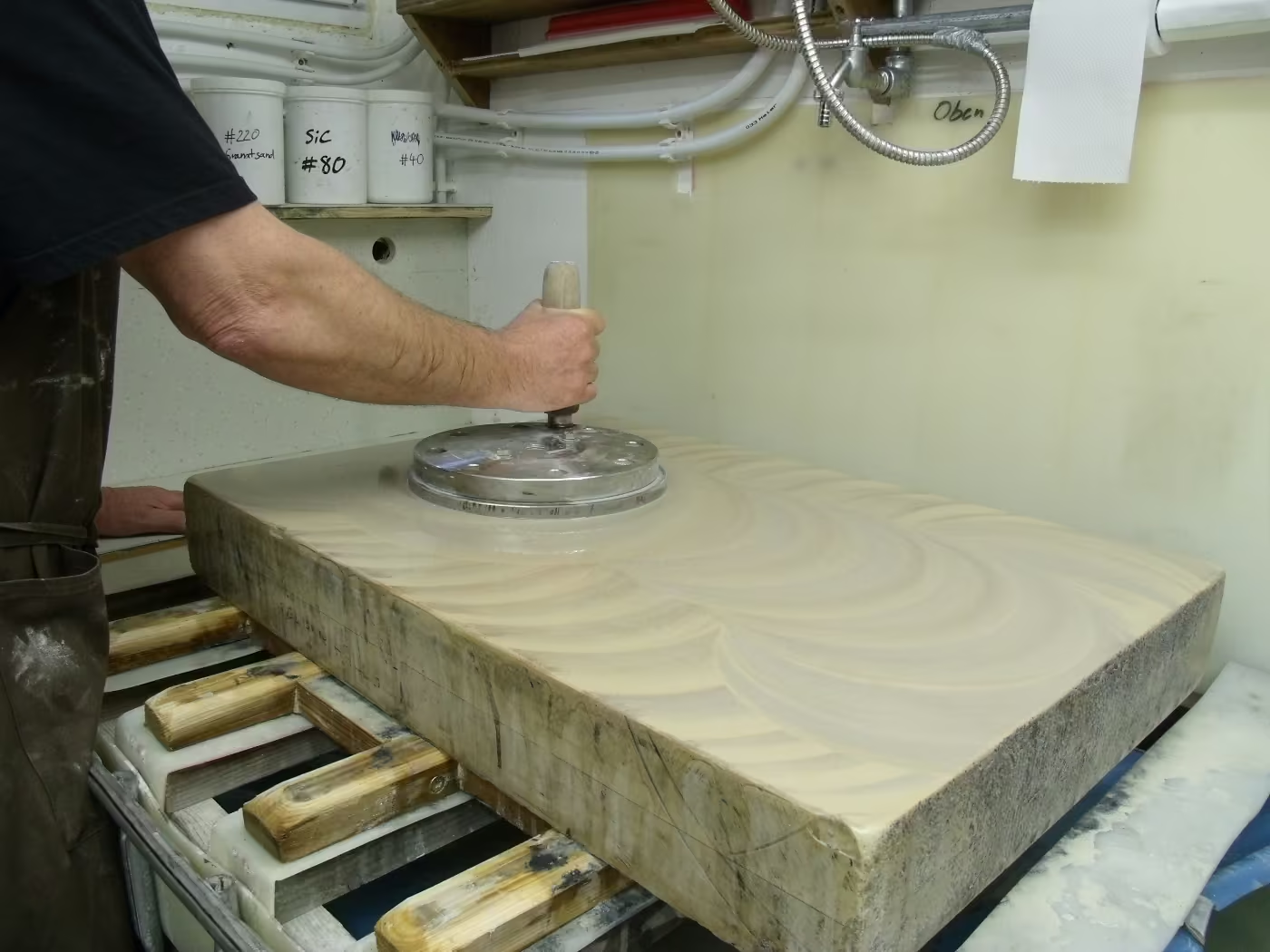
The printing surface, traditionally a block of fine-grained Bavarian limestone, is ground flat and smooth. The grain of the stone affects how the drawing materials adhere and how the finished print looks. A coarser grain produces a more textured, granular mark; a finer grain allows for sharper lines and smoother tonal areas. The stone is cleaned thoroughly to remove any traces of previous work and/or grease before drawing begins.
2. Drawing the image
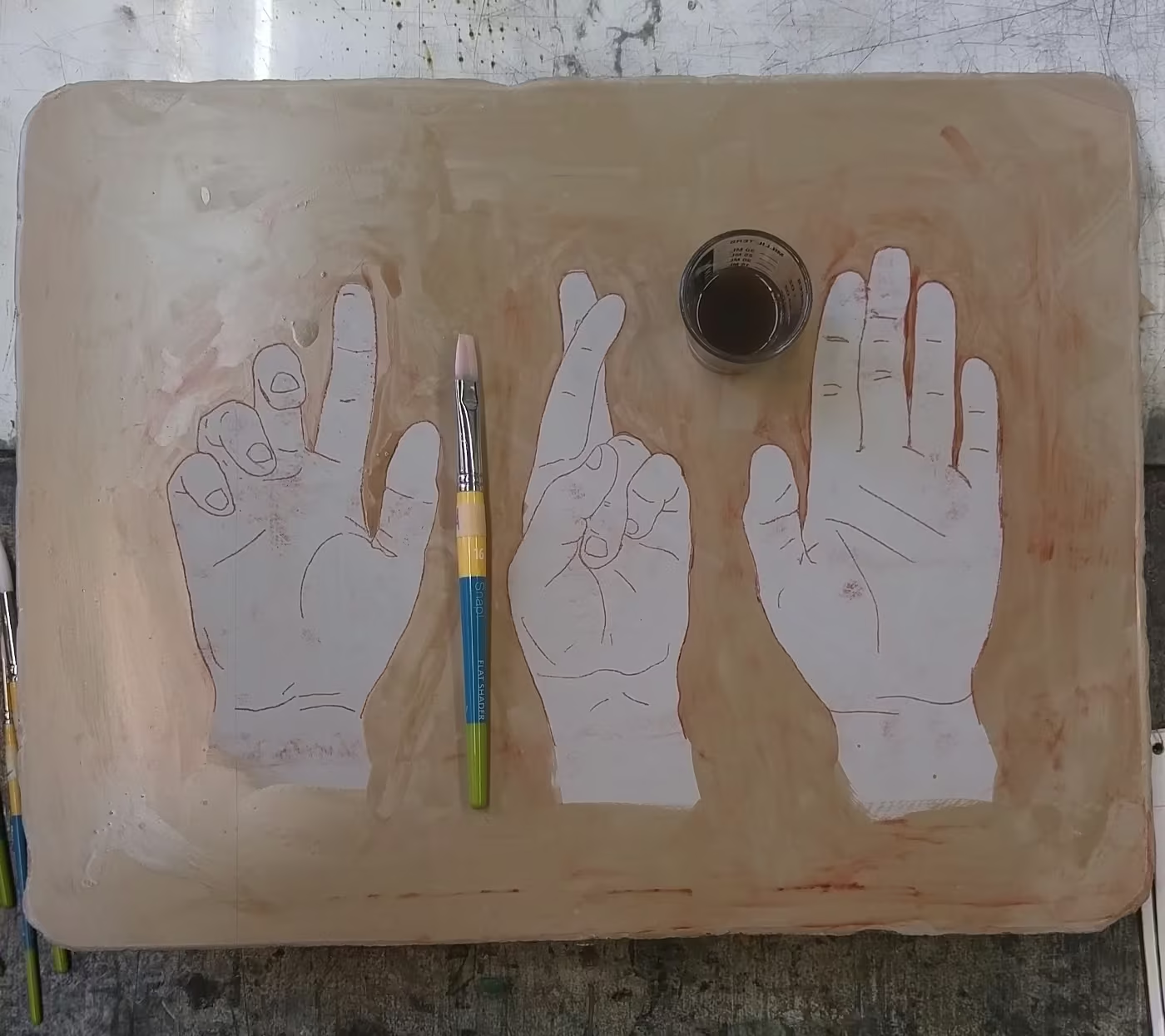
The artist draws directly onto the prepared surface using oil-based drawing materials. The most common are lithographic crayons and pencils (which produce a range of tonal marks depending on pressure) and tusche, a liquid drawing medium that can be applied with a brush or pen. Whatever marks are made on the stone become the image: lithography is a fully direct, autographic process.
Because the artist is drawing on a flat surface rather than cutting into it, lithography supports a wide range of mark-making approaches, from delicate pencil work to bold brushed passages.
3. Etching the stone
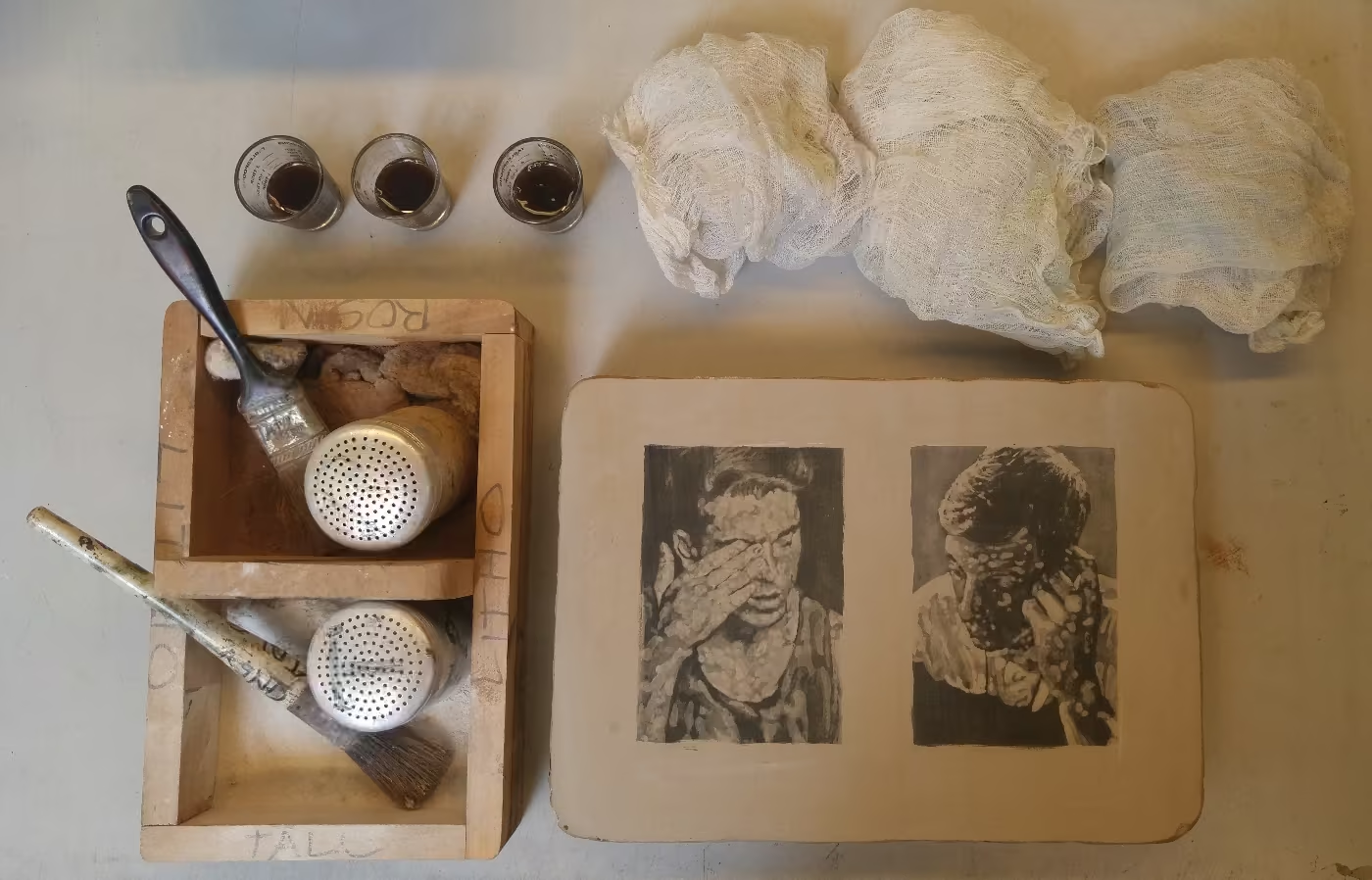
Once the drawing is complete, rosin and talc are dusted across the surface to protect the image, and the stone is treated with a solution of gum arabic and a small amount of nitric acid. This is called etching the stone, though no material is physically removed. The treatment desensitizes the blank areas of the stone so they become hydrophilic (water-attracting) and reinforces the oleophilic (oil-attracting) character of the image areas.
After the first etch has dried, the drawing materials are washed away with solvent and ink is rolled into the image areas for the first time, a stage called the roll-up. This confirms the image is stable and allows for any corrections before the edition is printed. A second etch is then applied, locking in the chemical differentiation across the whole surface. When the gum layer is removed and the stone dampened, the image is ready to print.
4. Inking and printing

Before printing each impression, the stone is dampened with water and rolled with ink. Because of the previous etching step, the non-image areas repel the ink while the image areas accept it. This is the central mechanism of the lithography in action: the ink sticks where the drawing was, and only there.
A sheet of paper is placed on the inked stone and covered with a tympan before running through a litho press, which applies firm lateral pressure through a scraper bar across the back of the paper, transferring the ink to the paper’s surface. The paper is peeled back to reveal the fresh impression. The stone is re-dampened and re-inked before each subsequent print.
Types of lithography
Lithography encompasses several related processes that share the same oil-and-water principle but use different printing surfaces. The type of surface affects the character of the printed mark and the scale of the edition.
Stone lithography
Stone lithography uses blocks of fine-grained Bavarian limestone as the printing surface. It is the original form of the process and is still widely practiced in fine art studios and printmaking programs. The limestone has a natural porosity and grain that produces a quality of mark not easily replicated on other surfaces: tonal passages have a characteristic granularity, and lines drawn with a lithographic crayon have a distinctive texture.
Working on stone requires specialist equipment, including a heavy litho press and facilities for grinding and preparing the stone. The stones themselves are reusable: once an edition is complete, the surface is ground flat and prepared for a new drawing.
Aluminum plate lithography
Aluminum plates are the standard metal surface used in fine art lithography studios today. Lighter and easier to handle than stone, aluminum plates can be stored flat, prepared with the same drawing materials as stone, and processed using gum arabic and acid in much the same way. The surface is more uniform than limestone, without the natural grain that characterises stone, which produces a slightly different mark quality — cleaner and more consistent, though less textured.
Aluminum became the dominant metal plate through the 20th century, gradually replacing zinc in both fine art and commercial contexts.
Zinc plate lithography (zincography)
Zinc was the first metal widely adopted as an alternative to limestone in lithographic printing, coming into common use during the mid-19th century. The process of printing from zinc plates is known as zincography. Zinc has a natural affinity with lithographic drawing materials and accepts a grain that gives it surface qualities closer to stone than aluminum, making it a preferred choice for some fine art printmakers.
It was widely used in commercial lithographic printing through the late 19th and early 20th centuries before aluminum became the industry standard. Zinc plates are less common in contemporary studio practice but are still used by printmakers who prefer the surface character they offer.
Polyester plate lithography
Polyester plate lithography (often called Pronto plate lithography, after one of the most common plate brands) uses coated polyester sheets as the printing surface. Images can be drawn directly onto the plate with lithographic drawing materials, toner-based drawing materials, or transferred from a laser-printed acetate. The plates are lightweight, inexpensive, and can be used on an etching press or a relief press with a flat bed, making the process significantly more accessible than stone or metal plate work.
Polyester plate lithography is widely used in educational settings and by printmakers who want to explore the lithographic process without the overhead of a dedicated litho press. The mark quality is less nuanced than stone or metal, but the process is a practical and legitimate form of lithography.
Offset lithography
Offset lithography is the dominant commercial printing process worldwide, used to produce books, magazines, packaging, and most printed matter. It is based on the same oil-and-water principle as fine art lithography but operates very differently in practice.
In offset printing, the image is transferred from an aluminum plate to a rubber blanket cylinder, which then transfers the image to the paper or substrate. The offset step means the plate never contacts the paper directly, which reduces plate wear and allows for faster, higher-volume printing. The process uses four-color Cyan, Magenta, Yellow, and Key black (CMYK) ink separation rather than the hand-applied oil-based inks of fine art lithography.
Offset lithography is not a fine art printmaking process. Prints produced by offset lithography are reproductions, not original multiples.
Mokulito (wood lithography)
Mokulito uses a plywood block as the printing surface in place of stone or metal. The same oil-and-water principle applies: the image is drawn onto the sanded wood surface using lithographic drawing materials such as tusche or oil-based pens, gum arabic is applied to desensitize the blank areas, and the plate is left to rest for several days before printing. The wood is kept damp during printing and inked with a roller in the same way as stone lithography. An etching press can be used in place of a dedicated litho press.
The technique was developed in Japan in the 1970s by Seishi Ozaku, a professor at Tama Art University in Tokyo, and was later developed further by Polish printmakers Józef and Ewa Budka. It has become increasingly popular as an accessible, low-toxicity alternative to stone and metal plate lithography, requiring no acids and no specialist press.
Mokulito produces small editions (typically fewer than fifteen impressions) as the wood matrix is less stable than stone or metal and gradually deteriorates through the print run. The wood grain of the block may appear as a plate tone in the printed image, which is a characteristic quality of the process. The matrix can also be carved like a woodcut, combining lithographic tonal marks with relief cutting on the same surface.
A brief history of lithography
Invention and early spread
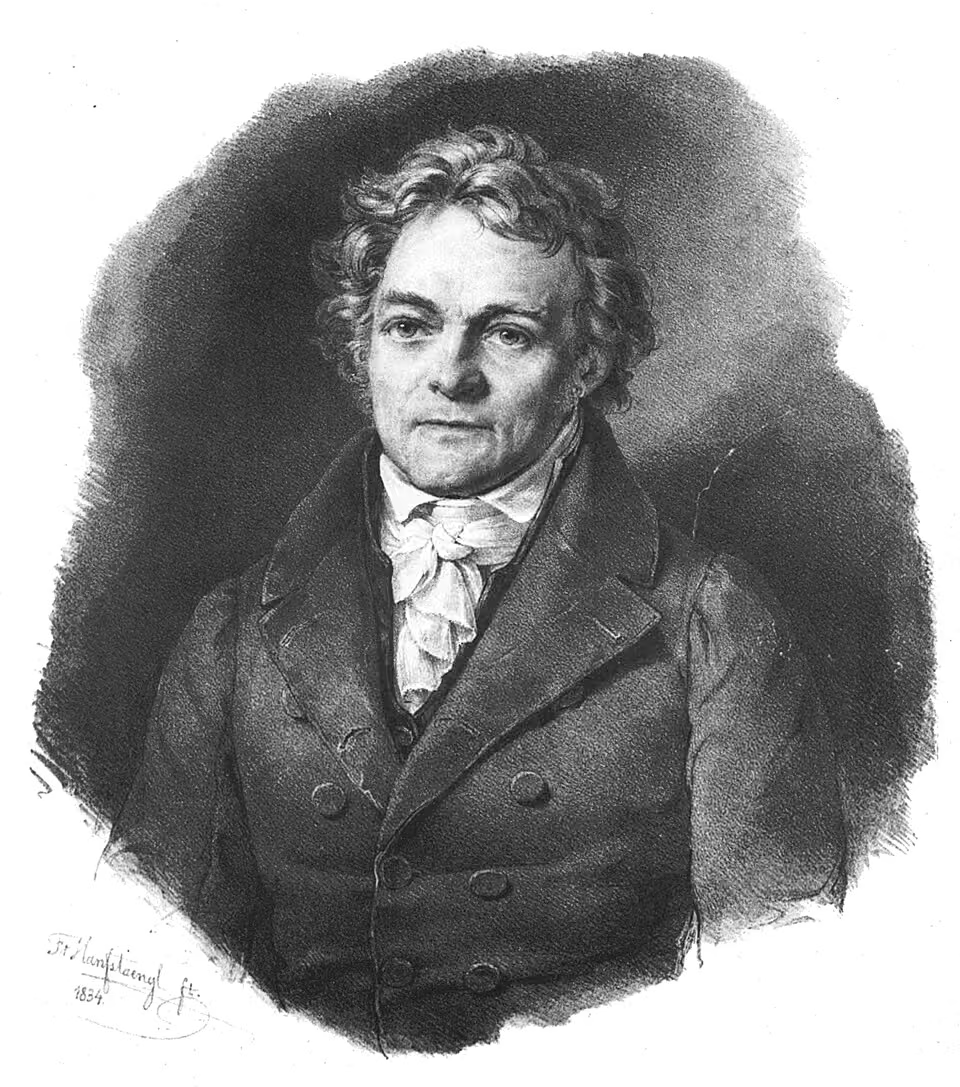
Lithography was invented by Alois Senefelder, a German playwright, in Bavaria around 1796. Senefelder was looking for an affordable way to reproduce his theatrical writings and discovered that a drawing made on limestone with a greasy crayon could be used to print multiple copies. He refined the process over the following years and published a comprehensive account of it, Vollstaendiges Lehrbuch der Steindruckerey, in 1818, which spread the technique rapidly across Europe.
The process was adopted quickly for commercial use: maps, music scores, illustrations, and printed announcements were all produced by lithography in the early 19th century. It was faster and cheaper than engraving for many applications and allowed for a much wider range of drawn marks.
Color lithography and the poster tradition
The development of chromolithography, printing in multiple colors using a separate stone for each color, opened new possibilities for commercial illustration in the mid-19th century. Lithographic posters became a significant visual medium in the second half of the century, particularly in France. The work of Jules Chéret and then Henri de Toulouse-Lautrec brought the lithographic poster to widespread public attention as a distinctive art form.
Toulouse-Lautrec's Moulin Rouge posters from the 1890s are among the most recognized works in the history of printmaking. His use of flat color, bold outline, and the specific tonal qualities achievable through lithography defined the look of the modern poster and established lithography as a medium capable of serious artistic expression.

Alphonse Mucha extended this tradition in a different direction. His posters of the 1890s, such as the Job cigarette paper series of 1896–97, used the possibilities of color lithography to produce highly decorative images distinguished by sinuous line, intricate ornamental patterning, and a close integration of figure and typography. Where Toulouse‑Lautrec’s lithographs were bold and economical, Mucha’s were dense and jewel‑like, demonstrating the range of effects the process could achieve.

Lithography as a fine art medium
By the late 19th century, artists including Paul Gauguin, Edvard Munch, and Odilon Redon were using lithography as a primary medium for original fine art work, not just reproduction. The directness of the process, drawing on stone as one might draw on paper, made it attractive to artists who valued spontaneity.
In the 20th century, major print studios became centers for artistic collaboration. The Mourlot studio in Paris worked closely with Pablo Picasso, Marc Chagall, Henri Matisse, and Joan Miró on significant lithographic projects. Tatyana Grosman's Universal Limited Art Editions in New York brought lithography to a new generation of American artists in the 1950s and 1960s.

Today, stone lithography remains an active practice in fine art studios and university printmaking programs worldwide. Alongside aluminum plate, zinc plate, and polyester plate methods, it continues to be one of the most technically demanding and expressive processes in the printmaker's toolkit.
How lithography differs from other printmaking processes
Lithography is a planographic printmaking process — one of the main categories of printmaking, which also includes intaglio, relief, stencil, and digital. Understanding how lithography differs from processes in those other categories helps clarify what makes a lithograph distinct.
Lithography and intaglio (etching, engraving)
Intaglio processes such as etching and engraving work by incising lines into a metal plate. Ink is pressed into those lines and wiped from the surface; the paper is then pressed into the plate under heavy pressure to pick up the ink from the incised areas. The resulting prints often show a plate mark at the edges and have a characteristic quality of line.
Lithography, by contrast, involves no cutting or incising. The image and the blank areas are on the same flat surface, differentiated only chemically. The marks possible in lithography, from soft tonal washes to delicate crayon work, are distinct from the crisp bitten lines typical of etching.
Lithography and relief printing (woodcut, linocut)
In relief printing, the non-image areas of the block are cut away, leaving a raised surface that carries the ink. The mark quality is determined largely by the cutting tool and the carving material. Lithography leaves the surface entirely intact and creates no physical relief at all.
Lithography and screen printing (serigraphy)
Screen printing is a stencil process: ink is pushed through the open areas of a mesh screen onto the paper below. It has no matrix in the traditional sense. Like lithography, screen printing can produce both fine art multiples and commercial reproductions depending on how it is used — the process itself does not determine whether the result is an original print.
Lithography and reproduction prints (giclée, offset lithograph)
The comparisons above are between original printmaking processes. Giclée and offset lithograph are a different kind of distinction.
A giclée is a high-resolution inkjet print produced from a digital file using pigment-based inks. It is typically a reproduction of a pre-existing original work, though when a work is digitally originated with no physical prior, the giclée may be the only form the work takes.
An offset lithograph is a reproduction produced by commercial printing machinery. Neither involves an artist working directly on a matrix. The term "lithograph" in "offset lithograph" refers to the mechanical printing principle, not to the fine art process described on this page.
The key distinction is authorship of the matrix. If the artist created and worked the surface being printed from, the result is an original print. If a machine has photographically or digitally copied an existing image to produce it, the result is a reproduction.
Frequently asked questions
What is a lithograph?
A lithograph is a print produced by the lithographic process, in which an image drawn onto a flat surface with oil-based materials is printed using the separation of oil and water. In fine art printmaking, a lithograph is an original multiple: each impression is printed directly from a matrix drawn by the artist.
What is the difference between a lithograph and a print?
A print is a broad term for any work produced by a printmaking process. A lithograph is one specific type of print, made by the lithographic process. The confusion often arises because the word print is also used loosely to mean any reproduction, including posters and giclées. A lithograph is an original print, not a reproduction.
Is a lithograph an original work?
Yes. In printmaking, an original print is one in which the artist created the matrix by hand and printed from it directly. A lithograph meets this definition: the artist draws on the stone or plate, and each impression pulled from that surface is considered an original. This distinguishes a lithograph from a reproduction, which copies a pre-existing image rather than printing from a hand-made matrix.
What is the difference between a lithograph and an etching?
Lithography is a planographic process: the image is on a flat surface and transfers through the chemical separation of oil and water.
Etching is an intaglio process: the image is incised into a metal plate and ink fills the incised areas before being transferred to paper under pressure.
The two processes produce visually distinct work. Etchings typically show precisely bitten lines and may have a visible plate mark; lithographs can carry a wider range of drawn and tonal marks, closer in character to drawing on paper. Both are original multiples in fine art printmaking.
What is the difference between a lithograph and a serigraph?
A serigraph (screen print) is made by pushing ink through a mesh stencil onto paper. A lithograph is made by transferring ink from a chemically treated flat surface. Both are original multiples in fine art printmaking. The processes produce quite different visual results: screen printing is often associated with flat, opaque color fields, while lithography supports a wider range of tonal and drawn mark-making.
What is offset lithography?
Offset lithography is a commercial printing process based on the same oil-and-water principle as fine art lithography. The image is transferred from a plate to a rubber blanket cylinder before printing onto paper. It is used for high-volume commercial printing of books, magazines, and packaging. Offset lithography is not a fine art printmaking process, and offset-printed items are reproductions, not original multiples.
What characteristic is associated with lithography?
The defining characteristic of lithography is that it is a planographic process: the printing surface is flat, and the image transfers through the chemical separation of oil-based ink and water rather than through physical relief or incised grooves. The oil-based drawing materials in the image areas attract ink; the dampened non-image areas repel it.
What is planographic printing?
Planographic printing refers to any printing process in which the image and non-image areas are on the same flat surface, with no physical relief or incising. Lithography is the primary planographic printmaking process. The image is created chemically rather than physically, through the selective attraction and repulsion of oil-based ink and water.