Stencil printmaking
Ink is pushed through openings in a stencil or mesh onto the paper. The blocked out areas do not print, and only the open shapes allow ink to pass through.
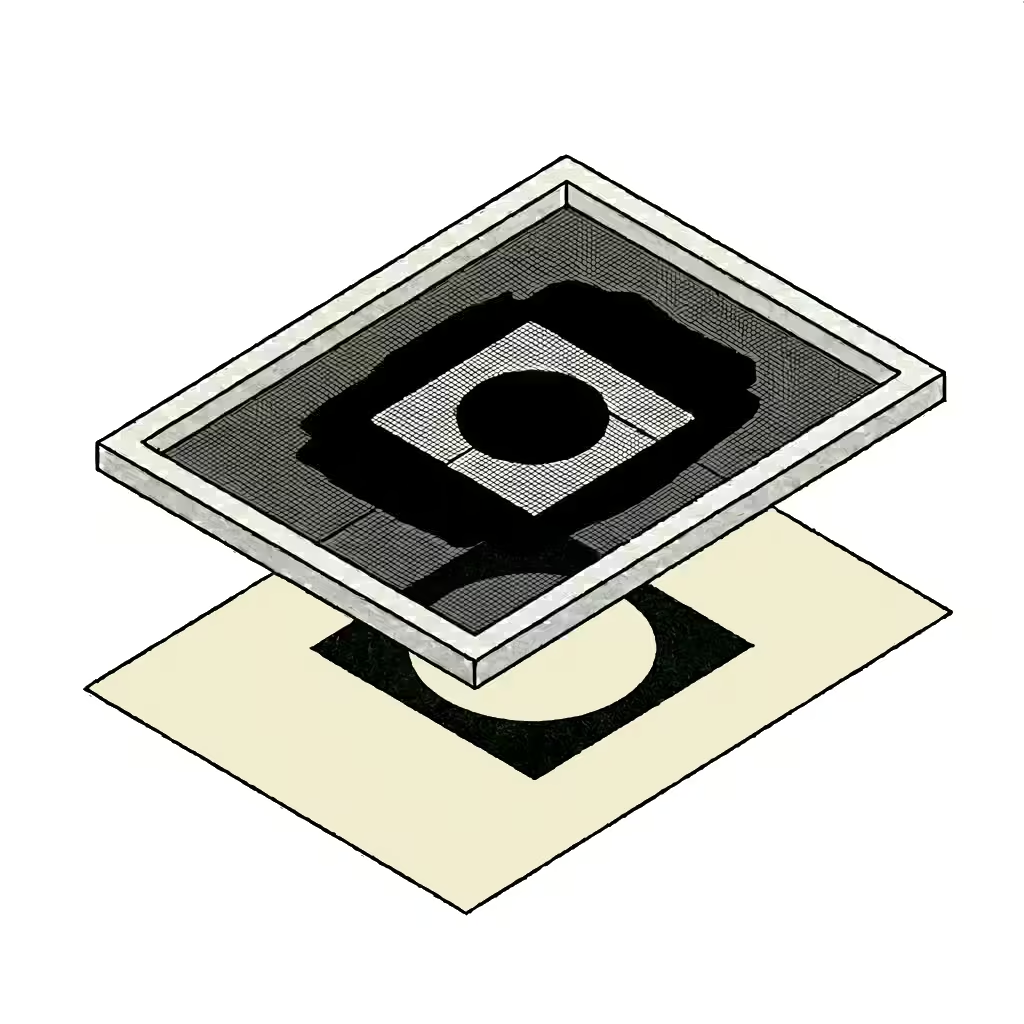
Table of contents
Stencil printmaking is a type of printmaking in which ink is transferred through open areas of a stencil onto a surface below. The stencil blocks ink in some areas while allowing it to pass through others, forming the printed image.
This printmaking type is defined by masking and openness, rather than by raised surfaces, recessed lines, or chemical separation. Some of the most widely used printmaking processes today—including screen printing—belong to stencil printmaking.
What is stencil printmaking?
Stencil printmaking works by placing a stencil between the ink source and the printing surface. Wherever the stencil is open, ink is forced through the opening and onto the surface below. Wherever it is blocked, ink is prevented from reaching the surface.
In simple terms:
- Ink moves through openings, not from a carved surface
- The image is created by blocking and revealing areas
- The stencil itself controls where ink appears
Stencil printmaking can be used on paper, fabric, and many other materials.
How stencil printmaking works
All stencil printmaking processes follow the same basic principle:
- A stencil is created
The stencil defines which areas will print and which will remain unprinted. - Ink is applied across the stencil
Ink is pushed, pulled, or pressed across the stencil surface. - Ink passes through open areas only
The stencil blocks ink in some areas and allows it through in others. - The image transfers to the surface below
Paper, fabric, or another material receives the printed image.
The specific tools and materials vary by process, but the core mechanism—printing through a stencil—remains the same.
Key characteristics of stencil prints
Stencil prints often share these features:
Defined shapes and edges
Images are built from areas that are either open or blocked, resulting in clearly defined shapes. Edges can appear crisp or deliberately soft depending on how the stencil is made and used.
Flat or layered areas of color
Stencil prints can produce both bold shapes and fine detail. Stencil prints are well suited to bold, graphic imagery.
Repeatability
A single stencil can be used multiple times to produce consistent impressions, allowing images to be repeated, layered, or built up across a series.
Adaptability across surfaces
Stencil printmaking can be used on paper, fabric, and nontraditional materials, making it one of the most versatile printmaking types.
Direct control of the image
The stencil itself determines the image structure. The printing surface plays a secondary role compared to how the stencil is designed, cut, or prepared.
Common stencil printmaking processes
Stencil printmaking includes several distinct processes, each using stencils in different ways.
Screen printing
Screen printing is a stencil-based printmaking process in which a mesh screen holds a stencil that blocks ink in certain areas. Ink is pushed through the open mesh using a squeegee to create the image.
Screen printing can be done:
- On paper, for fine art prints and posters
- On fabric, for textiles, clothing, and soft goods
Risograph
Risograph printing is a stencil-based duplicating process that uses a master stencil wrapped around a drum. Ink passes through the stencil to create printed images, often characterized by bright colors and visible layering.
While commonly associated with publishing and graphic design, risograph printing operates on stencil principles and is often discussed in relation to stencil printmaking.
Pochoir
Pochoir is a stencil printmaking process in which color is applied by hand through carefully cut stencils. It is known for rich, opaque color and precise application and has been used historically in fine art and illustrated books.
Mimeography
Mimeography is an early stencil-based duplicating process in which ink is pressed through a cut or typed stencil to reproduce text and images. It was widely used for educational and administrative printing before modern photocopying.
Mimeography is largely historical today, but it is important for understanding how stencil-based printing expanded beyond fine art into everyday use.
Stencil printmaking in art and visual culture
Stencil printmaking has been used across cultures and contexts, from hand-cut decorative stencils to large-scale graphic reproduction. Artists and designers have turned to stencil processes for their efficiency, clarity, and ability to reproduce images consistently.
Stencil-based methods have also played a key role in:
- Publishing and independent printing
- Textile and pattern design
- Political posters and activist graphics
These processes blur the line between fine art, design, and mass communication.
Stencil vs other printmaking types
Stencil printmaking differs fundamentally from other printmaking types:
Stencil vs relief printmaking
Relief printmaking transfers ink from raised surfaces. Stencil printmaking transfers ink through open areas.
Stencil vs intaglio printmaking
Intaglio printmaking transfers ink from recessed lines below the surface. Stencil printmaking does not rely on depth.
Stencil vs planographic printmaking
Planographic printmaking relies on chemical separation on a flat surface. Stencil printmaking relies on physical blocking and openness.
Each type is defined by a distinct method of controlling where ink prints.
How to explore stencil printmaking on World of Printmaking
This page introduces stencil printmaking as a printmaking type. To explore further, individual stencil printmaking processes—such as screen printing or pochoir—are covered in more detail on their own pages.
World of Printmaking is structured to help you understand:
- How different printmaking types work
- How processes relate to each other
- Why methods like screen printing belong within printmaking taxonomy
Stencil printmaking may span fine art, design, and reproduction, but it remains defined by one core idea: printing through a stencil.