Mezzotint
Also known as:
The plate is first meticulously roughened with a rocker to create a textured surface that prints rich, velvety blacks. Areas are then smoothed or burnished to produce lighter tones, resulting in prints with exceptionally soft gradients.
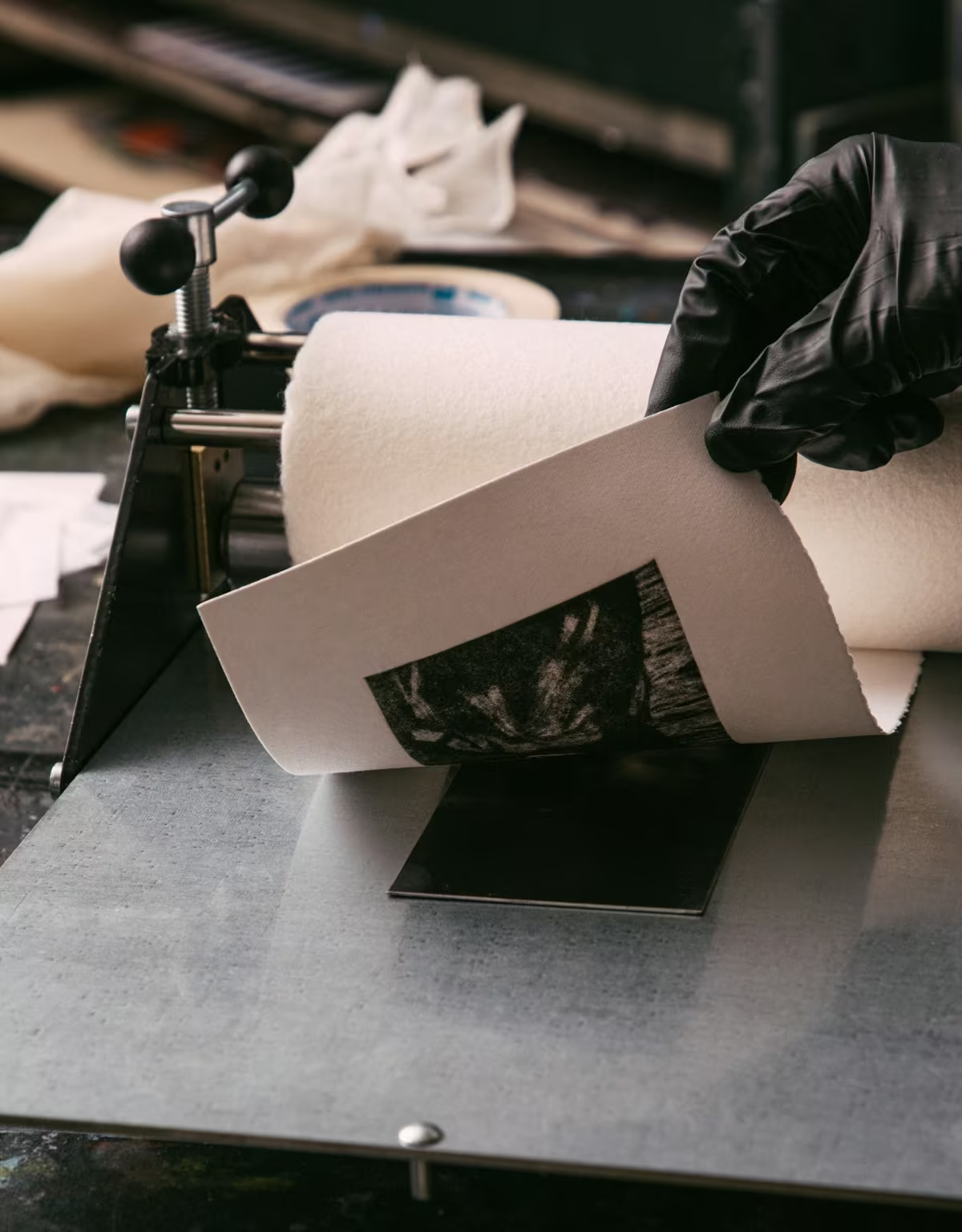
Source: Jackson’s Art Supplies
Table of contents
Mezzotint is an intaglio printmaking process that works in reverse to almost every other print process: rather than creating marks that will print, the printmaker starts with a surface that would print as a solid, velvety black across its entire area, then selectively smooths and polishes areas to produce lighter tones. The image emerges from dark to light.
The word comes from the Italian mezzotinto, meaning half-tone — a direct reference to the rich, continuous tonal gradation between dark and light that is the defining quality of the process.
What is mezzotint?
Mezzotint is an intaglio printmaking process. In intaglio printing, ink is held in recessed marks in the surface of a metal plate and transferred to paper under pressure.
What makes mezzotint structurally unlike any other intaglio process is how those recesses are created: not by drawing lines, cutting grooves, or biting acid into the plate, but by systematically roughening the entire surface until it holds ink evenly across every millimeter.
A plate prepared in this way, if inked and printed without further work, would produce a print of uniform, dense black. The image is made by working back from this state, smoothing and polishing selected areas of the roughened surface so they hold less ink, creating lighter tones. Fully smoothed areas hold no ink and print as white. Areas left untouched remain the original deep black. Anything in between prints as varying shades of grey, depending on how much of the surface has been worked back.
The word mezzotint refers to both the process and the print it produces. Mezzotinto in Italian means half-tint or half-tone, a name that points directly to what the process does: it produces prints in which tone is the primary expressive element, with no lines, no hatching, and no hard edges unless deliberately introduced. The gradations from dark to light are continuous, not stepped.
This tonal quality is what sets mezzotint apart from every other printmaking process and is the reason artists have chosen it across nearly four centuries. Its characteristic deep, luminous blacks and smooth tonal transitions are unlike anything achievable by etching, engraving, lithography, or any other print method.
How mezzotint works
The mezzotint process follows three distinct stages: preparing the ground, working back the image, and printing.
1. Rocking the plate

The plate (traditionally copper) is systematically worked across its entire surface with a rocker, a curved steel tool with a serrated, crescent-shaped blade.
The rocker is pressed firmly against the plate and rocked back and forth in short strokes, raising tiny burrs across the surface as the teeth bite into the metal. The printmaker works in overlapping passes, rotating the direction with each new pass, until the whole surface is uniformly covered with these fine burrs and pits.
This is called rocking the plate, and the resulting surface is the mezzotint ground.
The mezzotint ground, if inked and printed at this stage, holds ink in every one of those tiny pits and around every raised burr, producing a dense, velvety black across the entire plate. The quality and uniformity of this ground determines the quality of the finished print: an uneven ground where some areas are less thoroughly worked than others produces patches of unintended lighter tone in the darkest areas of the image.
Rocking a full plate is a laborious process. A medium-sized plate worked to a proper, even ground can take many hours of systematic effort.
The rocker is available in different grades of fineness; a coarser rocker works faster but produces a coarser grain, while a finer rocker takes longer and produces a more refined surface. Many printmakers own several and work progressively through grades.
2. Working back the image

Once the ground is complete, the printmaker works the image by selectively reducing the surface with two tools: a burnisher and a scraper.
The burnisher is a smooth, highly polished steel tool with a rounded tip. Pressed against the mezzotint ground and worked in overlapping strokes, it gradually flattens the burrs, reducing their ability to hold ink. The amount of burnishing applied controls the tone: light pressure over several passes creates a subtle mid-gray; heavier pressure, repeated many times, brings the surface close to a polished state that holds almost no ink and prints as near-white. Full burnishing to a mirror finish produces pure white in the print.
The scraper is a three-sided steel blade used to remove surface material more aggressively than the burnisher. It is useful for quickly opening up large light areas, for corrections, or for areas where the burnisher alone cannot achieve the required brightness.
Because the image is created by removing texture from the ground rather than adding marks to a blank surface, the entire tonal range from pure white to pure black is available at every point on the plate. Transitions between tones are genuinely continuous: not simulated through the density of lines or dots, but produced by a smooth gradation in how much of the surface texture remains. This is the source of mezzotint’s characteristic look, and its velvety, line‑free tonal range cannot be reproduced in exactly the same way by any other intaglio technique.
3. Printing
Mezzotint is printed as an intaglio process. Oil-based intaglio ink is applied across the entire plate surface and worked into the recesses. The surface is then wiped clean with a tarlatan cloth, leaving ink only in the pits and around the remaining burrs.
A sheet of dampened printmaking paper is laid over the plate, and both are placed beneath etching blankets on an etching press. The press applies firm, even pressure, forcing the damp paper into the fine recesses of the ground, lifting the ink and transferring the image. The paper is peeled back to reveal the print.
Dampened paper is essential: dry paper will not press into the fine recesses of the mezzotint ground deeply enough to lift the ink cleanly. The weight and surface character of the paper significantly affects the quality of the print, particularly in the shadow areas where the density of the ground determines the richness of the black.
Edition sizes in mezzotint are typically small. The burrs that give the ground its ink-holding capacity are gradually flattened by the pressure of printing, causing the rich blacks to become lighter and less velvety as the edition progresses. A mezzotint printed early in an edition will look measurably different from one printed toward its end. This fragility of the ground is one of the reasons mezzotints are relatively rare and their early impressions particularly prized.
Materials and tools
The plate
Copper is the traditional and still preferred plate material for mezzotint. It’s soft enough to take a good burr under the rocker, holds the fine texture of the ground well, and responds predictably to the burnisher.
Steel plates were widely used in commercial mezzotint engraving during the 18th and 19th centuries, where the hardness of the steel allowed larger editions before the ground wore down. Steel holds a finer grain than copper but is considerably harder to work. Contemporary fine art mezzotint is almost exclusively done on copper.
Zinc plates can also be used but do not hold a burr as well as copper and produce a less rich and less durable ground. For serious mezzotint work, copper is the right material.
The rocker
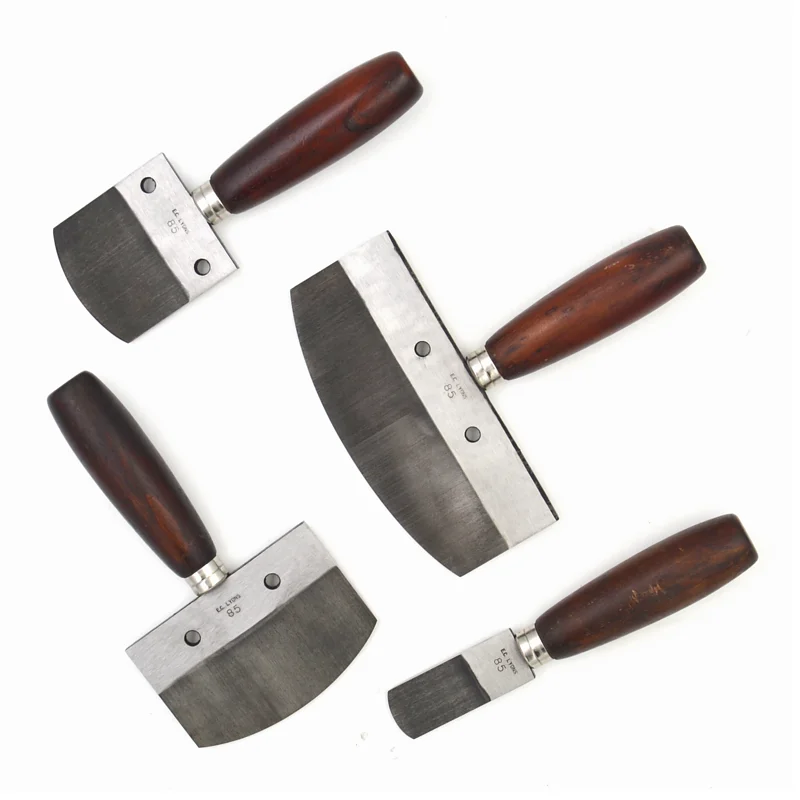
The rocker is the defining tool of mezzotint — no other printmaking process uses it. It consists of a curved steel blade with a serrated, crescent-shaped cutting edge, mounted in a wooden handle. When rocked back and forth across the copper plate with downward pressure, the teeth of the blade raise tiny burrs across the surface.
Rockers are available in different grades, measured by the number of teeth per centimeter or inch: finer rockers have more teeth per unit of width and produce a more refined grain. A coarser rocker works faster and is often used in the early stages of rocking to establish the ground quickly; finer rockers are worked over the surface afterward to refine it. The width of the blade also varies; wider rockers cover more area per pass and are suited to larger plates.
Good rockers are made by specialist tool manufacturers and are among the more expensive tools in the mezzotint printmaker's kit. The quality of the rocker directly affects the quality of the ground it produces.
The burnisher
The burnisher is the primary image-making tool in mezzotint. It is a smooth, highly polished steel tool, typically available in straight, curved, and pear-shaped forms, used to flatten the burrs of the mezzotint ground and reduce the surface's ability to hold ink.
The pressure applied and the number of passes determines how much tone is removed: a few light passes create a subtle shift toward gray; sustained heavy pressure brings an area to near-white or full white.
Different burnisher shapes suit different tasks: a curved or pear-shaped burnisher is useful for broad tonal areas; a narrower, straighter burnisher allows more controlled work in smaller areas. Many mezzotint printmakers work with several burnishers of different profiles.
The scraper
The scraper is a three-sided steel blade used to remove surface material from the plate more aggressively than the burnisher. It is used for opening up large, bright areas quickly, for making corrections when burnishing has not achieved the required tone, or when the surface needs to be reduced significantly. After scraping, the area is usually refined with the burnisher to smooth any roughness left by the blade.
Ink and paper
Mezzotint uses oil-based intaglio ink, the same type used for etching and engraving. The ink must be stiff enough to remain in the fine recesses of the ground during wiping while releasing cleanly to the paper under press pressure.
A slightly stiffer ink is generally preferred for mezzotint than for etching, as the fine burrs of the ground are more vulnerable to over-wiping.
Fine art papers, typically dampened before printing to make them more pliable and receptive, are standard for mezzotint edition work. The weight and surface of the paper affects how well it presses into the fine recesses of the ground and how the ink releases. Soft, smooth papers with good absorbency tend to produce the richest blacks and the cleanest tonal gradations.
The mezzotint image
The visual quality that defines mezzotint (and that no other printmaking process can reproduce in quite the same way) is the character of its black and the smoothness of its tonal transitions.
The black of a fully worked mezzotint ground is unlike the black produced by any other traditional print process. It comes from the density and uniformity of the burr: thousands of tiny pits and raised edges across every square millimeter of the plate, each holding a small amount of ink. In combination, they produce a depth and richness of black that etching lines, engraved marks, or lithographic ink cannot replicate in quite the same way. A correctly inked and printed mezzotint black has a velvety, almost three-dimensional quality that is immediately recognizable.
The tonal gradations in mezzotint are continuous rather than stepped or simulated. In etching and engraving, tone is built through hatching: networks of lines whose density and crossing create the visual impression of tone. Look closely at an etching and you will see the individual lines. In mezzotint, there are no lines. The transition from black to gray to white is smooth and unbroken, a product of the gradual reduction of the surface texture rather than any discrete mark. This gives mezzotint a quality of atmospheric depth and luminosity that is characteristic of the medium across both its historical and contemporary practice.
These qualities make mezzotint naturally suited to certain kinds of imagery. Portraits, nocturnes, candlelit interiors, and images with strong chiaroscuro have been recurring subjects in mezzotint since the 17th century, for the same reason: the process excels at rendering the subtle transitions between light and shadow that these subjects demand.
Contemporary mezzotint artists have extended the process into abstraction, landscape, and conceptual work, but the underlying tonal richness remains the medium's defining characteristic.
The limitation of mezzotint is the counterpart of this strength. Because the process is fundamentally tonal rather than linear, hard-edged or strongly graphic imagery usually requires combining mezzotint with another process such as etching or engraving. A line drawn in mezzotint alone — by burnishing a thin light stroke through the dark ground — will have a soft, slightly blurred quality. If a clean, hard line is required, it must be cut into the plate by another method.
A brief history of mezzotint
Mezzotint was invented in the mid‑17th century, generally credited to Ludwig von Siegen, a German soldier and amateur artist who produced the earliest known mezzotint portrait around 1642.
The process was taken up and significantly developed by Prince Rupert of the Rhine, a cousin of King Charles II, who brought the technique to England in the 1660s and shared it with a number of English engravers.
England became so dominant in mezzotint production during the 18th century that the process was known in Europe as la manière anglaise — the English manner.
English mezzotint engravers including John Raphael Smith, Valentine Green, and Richard Earlom produced large‑format reproductive prints after paintings by Reynolds, Gainsborough, Romney, and other leading portrait painters of the period.

Source: Wikimedia Commons

Source: Sulis Fine Art
Mezzotint was the preeminent medium for reproducing oil paintings before the invention of photography, precisely because its tonal qualities and its capacity for rich blacks and smooth gradations could approximate the chiaroscuro of paint more closely than any other print process available.
The invention of photography in the mid-19th century effectively ended commercial mezzotint engraving. If a painting could be photographed and reproduced mechanically, there was no longer a market for a laboriously hand‑worked reproductive print. Commercial mezzotint, which had been a major industry in England for over a century, contracted rapidly and then disappeared almost entirely within a generation.
Mezzotint survived as a fine art medium in the hands of artists who valued it for original work rather than reproduction. In the 20th century it was taken up by a number of significant printmakers, most notably the Japanese artist Yōzō Hamaguchi, who worked in mezzotint from the 1950s onward and produced prints of extraordinary luminous color and tonal delicacy that brought wide international attention to the medium.
%2C%201957%2C%20color%20mezzotint.avif)
Source: National Gallery of Art
Hamaguchi’s work demonstrated what mezzotint could do as a vehicle for original expression rather than reproductive craft, and his influence on subsequent generations of mezzotint printmakers has been considerable.
%2C%201948%2C%20mezzotint.avif)
Source: Escher in The Palace
Today mezzotint is practiced by a small but committed community of specialist printmakers worldwide. The laboriousness of the rocking stage, the cost of the tools, and the technical demands of working back the image make it one of the more challenging and less commonly practiced printmaking processes. Its prints are correspondingly among the most technically accomplished in the intaglio tradition, and early impressions from good mezzotint grounds are valued accordingly.
Mezzotint in relation to other intaglio processes
Mezzotint belongs to the intaglio family alongside etching, drypoint, aquatint, and engraving. All of these processes print from ink held in recesses in a metal plate. What distinguishes them is how those recesses are made and what kind of mark or tone they produce.
Mezzotint and etching
Etching and mezzotint are the most common pairing in the history of intaglio printmaking, and many plates combine both. Etching works by drawing through a wax or resin ground with a needle, then biting the exposed lines with acid. The result is a network of lines from which tone is built through hatching: the closer and more numerous the lines, the darker the tone. Mezzotint has no lines. Its tone is genuinely continuous, a product of surface texture rather than line density.
When combined on a single plate, the two processes complement each other directly: etched lines can provide structure, hard edges, and linear detail, while mezzotint tone provides the atmospheric shadow and tonal depth. Many of the great 18th-century reproductive mezzotints include etched work for the more defined passages of the image.
Mezzotint and aquatint
Aquatint is the other principal intaglio process used to create tonal areas rather than lines. It works by biting acid through a porous resin ground that has been dusted or sprayed onto the plate, producing a fine-grained tonal texture when printed. Like mezzotint, it is often combined with etching to add tone to a line-based image.
The tonal quality of the two processes differs significantly. Aquatint produces a slightly grainy, textured tone that reads differently at close range from the smooth, continuous tone of mezzotint. Mezzotint blacks are deeper and richer; aquatint can produce a wider range of tonal values more quickly. Both processes are vulnerable to wear across an edition, as the fine texture that produces the tone is gradually reduced by printing pressure.
Mezzotint and drypoint
Drypoint and mezzotint share one characteristic: both rely on physical burr raised on the plate surface to hold ink.
In drypoint, the burr is raised beside a line scratched directly into the plate with a sharp needle. In mezzotint, the burr covers the entire plate surface, created systematically by the rocker. In both cases, it’s the burr (not the incised mark itself) that holds the ink and produces the distinctive quality of the printed line or tone. And in both cases, the burr is fragile: printing pressure gradually flattens it, reducing the richness of the tone or the softness of the line across the edition.
Mezzotint and engraving
Engraving and mezzotint represent two fundamentally different approaches to tone in intaglio. Engraving is a linear process: the image is built from incised lines cut into the plate with a burin, and tone is created by the density, width, and spacing of those lines.
Mezzotint, by contrast, begins with a uniformly textured, non‑linear ground; tone emerges by selectively removing or smoothing burr rather than by adding lines.
When combined on a single plate, engraving and mezzotint complement each other directly. Engraved lines can provide crisp contour, fine detail, and strong graphic structure, while mezzotint tone supplies the soft shadows, subtle gradations, and deep blacks that give the image its atmospheric depth. Historically, this combination was used in some 18th‑ and 19th‑century reproductive prints to achieve both the clarity of line engraving and the tonal richness of mezzotint, though mezzotint’s delicate burr still limits how many impressions can be pulled before the softer tonal passages begin to flatten.
Frequently asked questions
What does mezzotint mean?
Mezzotint comes from the Italian mezzotinto, meaning half-tint or half-tone. The name refers directly to the rich, continuous tonal gradation between dark and light that is the defining quality of the process. A mezzotint is both the process and the print it produces.
What is the difference between mezzotint and etching?
Both are intaglio processes printed from a metal plate under pressure. Etching uses acid to bite lines drawn through a ground; tone is created through hatching (networks of lines). Mezzotint works by roughening the entire plate surface and selectively burnishing areas back to lighter tones. Its gradations are continuous and smooth, with no visible lines. Mezzotint blacks are richer and deeper than anything achievable in etching alone.
Why are mezzotints so dark?
The darkness of a mezzotint comes from the density of the roughened surface. A fully worked mezzotint ground is covered with thousands of tiny pits and burrs across every millimeter, each holding a small amount of ink. In combination they produce a depth and richness of black that is unique to the process. Areas that are not burnished back remain as this full ground, giving mezzotints their characteristic deep shadow tones.
How long does it take to make a mezzotint?
The rocking stage alone — uniformly roughening the plate surface — can take many hours for a medium-sized plate. Working back the image, testing tone through proofing, and making adjustments add considerably to that time. A complete mezzotint from plate preparation to finished edition is one of the most time-intensive processes in printmaking, which is reflected in both the rarity of the prints and their value.
Why are mezzotint editions so small?
The burrs raised by the rocker that give the mezzotint ground its ink-holding capacity are fragile. Printing pressure gradually flattens them across the edition, causing the rich blacks to become lighter and less velvety as more impressions are pulled. A mezzotint printed early in an edition will show noticeably richer tone than one pulled toward its end. Edition sizes are kept small to ensure all impressions are of comparable quality.
What subjects suit mezzotint best?
Subjects with strong tonal contrast, rich shadow areas, and subtle gradations between light and dark are where mezzotint is most naturally at home: portraits, nocturnes, candlelit scenes, and atmospheric landscapes. The process is less suited to hard-edged, linear, or graphic imagery, which requires combining mezzotint with etching or engraving to achieve clean lines. Contemporary mezzotint artists work across a wide range of subject matter, and some deliberately use the process’s softness for graphic or abstract effects, but the process’s tonal depth remains its defining quality regardless of subject.