Letterpress
Also known as:
Raised, movable type or relief blocks are inked on their surface. The raised areas transfer ink to the paper, producing clean, uniform impressions with a subtle debossed feel.
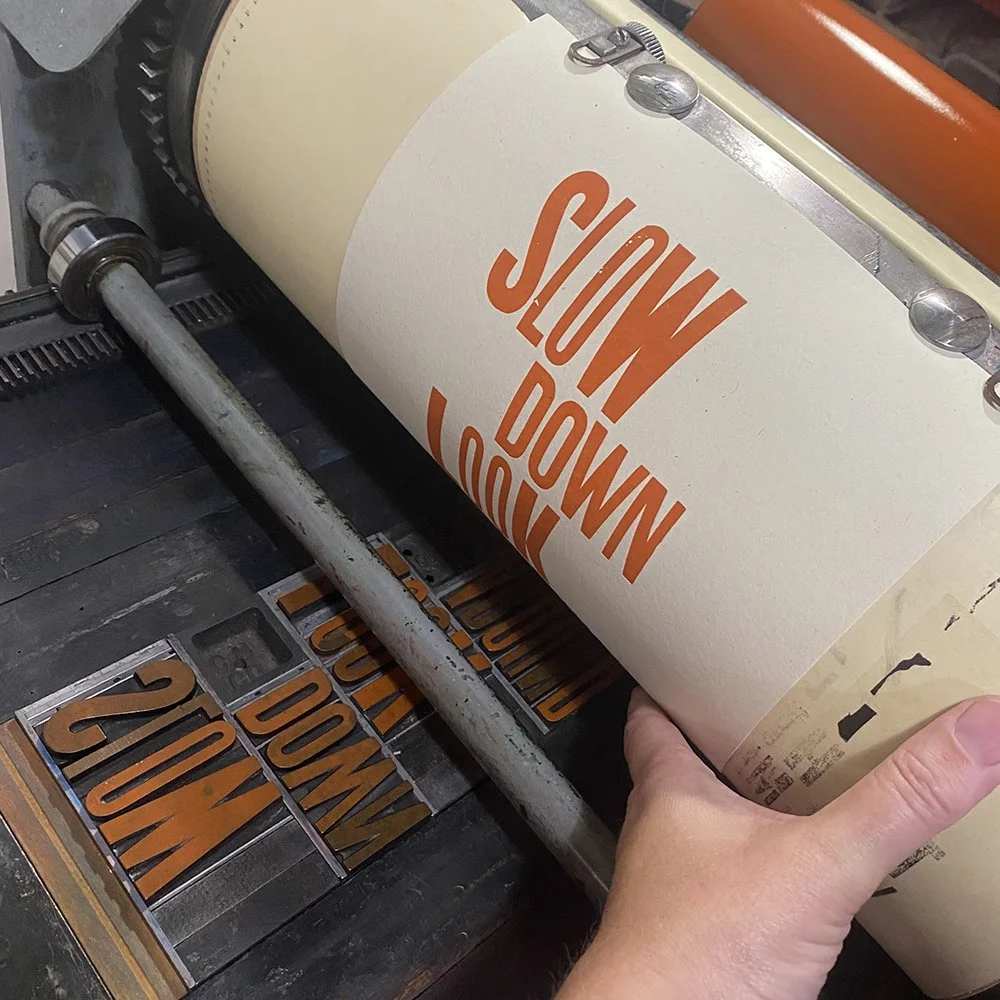
Letterpress print and inked movable type in a press during the printing process. Source: Starshaped Press
Table of contents
Letterpress is a relief printing process where raised elements—such as movable type, ornaments, or image plates—are inked and pressed directly into paper to transfer an image.
Because it prints from a raised surface rather than incised lines or recessed areas, letterpress shares the core principle of relief printmaking.
Letterpress is traditionally centered on text, typography, and precise compositional arrangement, but it also accommodates imagery through custom plates and carved blocks.
How letterpress printing works
At a conceptual level, letterpress printing involves:
- Arranging raised printing elements, such as movable type or plates
- Applying ink evenly to the raised surface with rollers
- Pressing paper firmly against the inked surface to transfer ink directly into the paper
Unlike image-based relief processes like woodcut or linocut, letterpress prioritizes exact alignment of letters and images, careful spacing between characters, and uniform ink depth across (often) hundreds of prints—key requirements for readable typography and high-volume printing.
Materials used in letterpress
Letterpress is defined by both its method and its materials.
Common materials include:
- Movable type, traditionally cast from metal or wood
- Relief plates, which may carry text or images
- Oil-based inks formulated for controlled transfer
- Paper, often chosen for its ability to receive an impression
The interaction between ink, pressure, and paper is central to letterpress printing and contributes to its distinctive surface qualities.
Key characteristics of letterpress prints
Letterpress prints are often recognized by:
- Crisp, well-defined letterforms or shapes
- Subtle impression where the inked surface meets the paper
- High control over spacing and alignment
- Strong emphasis on typography and layout
These qualities come from the process itself rather than from stylistic choices alone.
Letterpress in printing history
Letterpress played a foundational role in the history of printing. For centuries, it was the primary method used to produce books, pamphlets, and printed documents, making large-scale dissemination of text possible.
Although many modern printing methods have replaced letterpress for industrial use, the process remains important as both a historical technology and a contemporary printing practice. In modern contexts, letterpress is often used for finely printed books, stationery, invitations, and other objects where material quality, typography, and physical impression are central to the design.
Frequently asked questions about letterpress
Do letterpress prints require a press?
Letterpress is traditionally printed using a press to ensure consistent pressure and alignment, though some small-scale or experimental work may use alternative methods.
Can letterpress be combined with other printmaking processes?
Yes. Letterpress is often combined with other printmaking processes, particularly relief methods, allowing printers to pair typographic precision with expressive imagery or layered visual elements. In these contexts, letterpress may function either as a standalone process or as a complementary one.